Hamilton's Principle
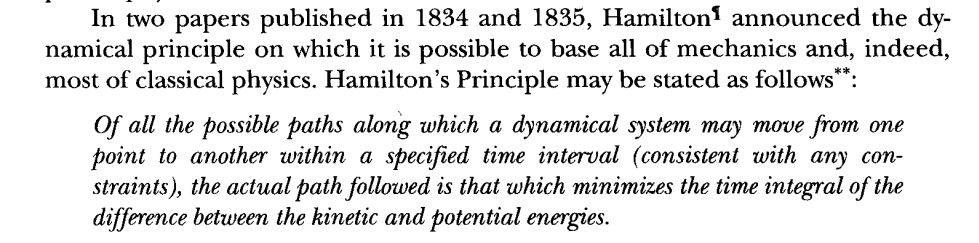
The path of a physical system between two states is the one that minimizes the difference between kinetic and potential energies.
Action:
The action is defined as the integral of the Lagrangian
Here,
Hamilton’s principle can be expressed as:
This means that the actual path a system takes is the one that makes the variation of the action zero.
To derive the equations of motion from this, we compute the variation
This leads to the Euler-Lagrange equations:
The Euler-Lagrange equations are the equations of motion that follow from Hamilton's principle.
- lookout Euler-Lagrange Equation .
- and Generalized Coordinates.